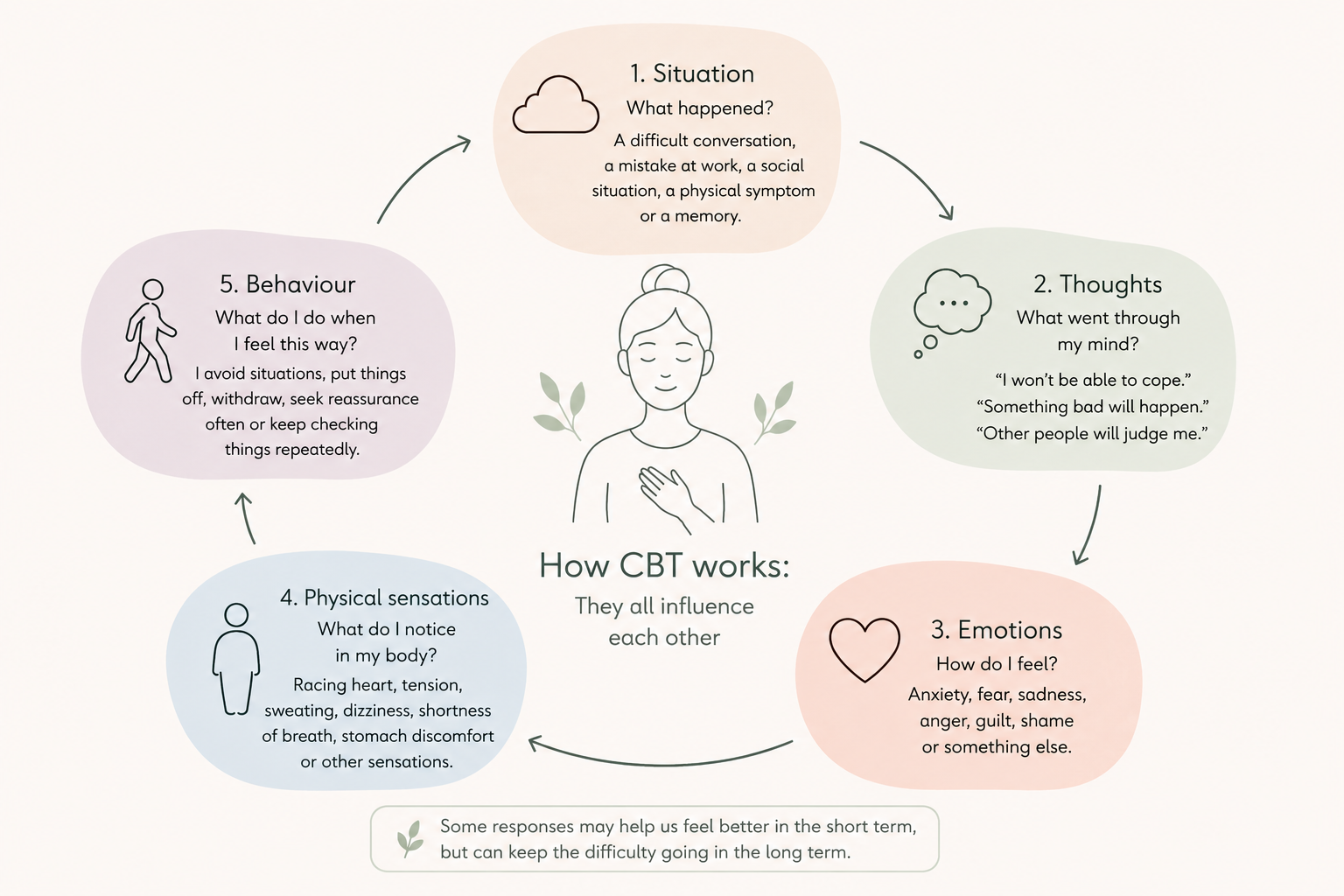
Cognitive Behavioural Therapy (CBT) is an evidence-based form of psychological therapy that helps us better understand the connection between the situations we experience, our thoughts, our emotions, our physical sensations and the way we behave.
The main idea behind CBT is that we are not only affected by what happens to us, but also by how we interpret and respond to what happens.
For example, two people may find themselves in the same situation but have very different thoughts about it, leading them to feel and respond in different ways.
In CBT, we work together to understand what is happening within your own cycle and identify what may be maintaining anxiety, low mood or another difficulty.
The Five Areas Model
A simple way of understanding a difficult experience is to look at five different areas.
Situation
What happened?
This could be a difficult conversation, a mistake at work, a social situation, a physical symptom or even a memory.
Thoughts
What went through my mind?
For example:
“I won't be able to cope.”
“Something bad is going to happen.”
“Other people will judge me.”
CBT is not simply about “thinking positively”. Instead, we learn to notice our thoughts and explore whether there may be a more balanced or helpful way of looking at a situation.
Emotions
How do I feel?
You might experience anxiety, fear, sadness, anger, guilt, shame or another emotion.
Physical sensations
What do I notice in my body?
For example, you might experience a racing heart, muscle tension, sweating, dizziness, shortness of breath or discomfort in your stomach.
Behaviour
What do I do when I feel this way?
You might avoid certain situations, put things off, withdraw from others, repeatedly seek reassurance or find yourself checking things over and over again.
Some of these behaviours may make us feel better in the short term, but in some cases they can keep the difficulty going in the long term.
Understanding vicious cycles
One of the important questions we explore in CBT is:
“What is keeping the difficulty going right now?”
For example:
Anxiety → Avoidance → Temporary relief → Less confidence → More anxiety
or
Low mood → Fewer activities → Less enjoyment and sense of achievement → Lower mood
Once we understand the cycle, we can begin to make small changes to the parts that may be keeping it going.
What do we do in CBT?
CBT is a collaborative approach to therapy.
Together, we work to understand the difficulty you are experiencing, when it tends to happen, what might trigger it, the thoughts and emotions that come up, how your body responds, how you usually cope with it and what may unintentionally be keeping the difficulty going.
From there, we can begin to explore practical strategies that may help you gradually change this cycle.
What happens between sessions?
CBT does not only take place during the therapy session.
An important part of therapy is having the opportunity to try out some of the things we discuss together in your everyday life.
For example, we might agree for you to notice certain thoughts, keep track of when anxiety appears, try responding differently to a situation, introduce an activity into your routine or gradually reduce avoidance.
These are not “homework assignments”, and there is no right or wrong way to do them. Everything we try gives us useful information and helps us better understand what works for you.
What can CBT help you gain?
Through therapy, you can gradually learn to:
• Better understand the difficulties you are experiencing.
• Recognise patterns of thinking and behaviour that may be holding you back.
• Develop practical tools that you can use in everyday life.
• Reduce avoidance and other behaviours that may be maintaining the problem.
• Feel more confident in managing difficult situations.
Remember
In CBT, we work step by step and towards the goals that matter to you.
The aim is not to never experience anxiety, fear or sadness again. These are normal human emotions.
Instead, the aim is to better understand your difficulties and develop practical skills that can help you respond to them with greater flexibility and confidence.